A 1985 study by R. Kumar, using British and American crash reports as data, suggested 57% of crashes were due solely to driver factors, 27% to combined roadway and driver factors, 6% to combined vehicle and driver factors, 3% solely to roadway factors, 3% to combined roadway, driver, and vehicle factors, 2% solely to vehicle factors, and 1% to combined roadway and vehicle factors. Reducing the severity of injury in crashes is more important than reducing incidence and ranking incidence by broad categories of causes is misleading regarding severe injury reduction. Vehicle and road modifications are generally more effective than behavioral change efforts with the exception of certain laws such as required use of seat belts, motorcycle helmets and graduated licensing of teenagers.
 Human factors in vehicle collisions include all factors related to drivers and other road users that may contribute to a collision. Examples include driver behavior, visual and auditory acuity, decision-making ability, and reaction speed.
Intent is also a factor, a vehicle-ramming attack for a example happens largely due to a driver choosing to cause a traffic collision.
A 1985 report based on British and American crash data found driver error, intoxication and other human factors contribute wholly or partly to about 93% of crashes.
Drivers distracted by mobile devices had nearly four times greater risk of crashing their cars than those who were not. Dialing a phone is the most dangerous distraction, increasing a drivers’ chance of crashing by 12 times, followed by reading or writing, which increased the risk by 10 times.
An RAC survey of British drivers found that most[quantify] thought they were better than average drivers; a contradictory result showing overconfidence in their abilities.[citation needed] Nearly all drivers who had been in a crash did not believe themselves to be at fault.One survey of drivers reported that they thought the key elements of good driving were:
Human factors in vehicle collisions include all factors related to drivers and other road users that may contribute to a collision. Examples include driver behavior, visual and auditory acuity, decision-making ability, and reaction speed.
Intent is also a factor, a vehicle-ramming attack for a example happens largely due to a driver choosing to cause a traffic collision.
A 1985 report based on British and American crash data found driver error, intoxication and other human factors contribute wholly or partly to about 93% of crashes.
Drivers distracted by mobile devices had nearly four times greater risk of crashing their cars than those who were not. Dialing a phone is the most dangerous distraction, increasing a drivers’ chance of crashing by 12 times, followed by reading or writing, which increased the risk by 10 times.
An RAC survey of British drivers found that most[quantify] thought they were better than average drivers; a contradictory result showing overconfidence in their abilities.[citation needed] Nearly all drivers who had been in a crash did not believe themselves to be at fault.One survey of drivers reported that they thought the key elements of good driving were:
 The U.S. Department of Transportations Federal Highway Administration review research on traffic speed in 1998. The summary says:
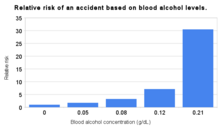 According to the Government of Canada, coroner reports from 2008 suggested almost 40% of fatally injured drivers consumed some quantity of alcohol before the collision.[32]
 A 1985 US study showed that about 34% of serious crashes had contributing factors related to the roadway or its environment. Most of these crashes also involved a human factor. The road or environmental factor was either noted as making a significant contribution to the circumstances of the crash, or did not allow room to recover. In these circumstances it is frequently the driver who is blamed rather than the road; those reporting the collisions have a tendency to overlook the human factors involved, such as the subtleties of design and maintenance that a driver could fail to observe or inadequately compensate for.
Research has shown that careful design and maintenance, with well-designed intersections, road surfaces, visibility and traffic control devices, can result in significant improvements in collision rates.
Individual roads also have widely differing performance in the event of an impact. In Europe there are now EuroRAP tests that indicate how self-explaining and forgiving a particular road and its roadside would be in the event of a major incident.
In the UK, research has shown that investment in a safe road infrastructure program could yield a ⅓ reduction in road deaths, saving as much as £6 billion per year. A consortium of 13 major road safety stakeholders have formed the Campaign for Safe Road Design, which is calling on the UK Government to make safe road design a national transport priority.
Research has shown that, across all collision types, it is less likely that seat belts were worn in collisions involving death or serious injury, rather than light injury; wearing a seat belt reduces the risk of death by about 45 percent. Seat belt use is controversial, with notable critics such as Professor John Adams suggesting that their use may lead to a net increase in road casualties due to a phenomenon known as risk compensation.However, actual observation of driver behaviors before and after seat belt laws does not support the risk compensation hypothesis. Several important driving behaviors were observed on the road before and after the belt use law was enforced in Newfoundland, and in Nova Scotia during the same period without a law. Belt use increased from 16 percent to 77 percent in Newfoundland and remained virtually unchanged in Nova Scotia. Four driver behaviors (speed, stopping at intersections when the control light was amber, turning left in front of oncoming traffic, and gaps in following distance) were measured at various sites before and after the law. Changes in these behaviors in Newfoundland were similar to those in Nova Scotia, except that drivers in Newfoundland drove slower on expressways after the law, contrary to the risk compensation theory.
A 1985 US study showed that about 34% of serious crashes had contributing factors related to the roadway or its environment. Most of these crashes also involved a human factor. The road or environmental factor was either noted as making a significant contribution to the circumstances of the crash, or did not allow room to recover. In these circumstances it is frequently the driver who is blamed rather than the road; those reporting the collisions have a tendency to overlook the human factors involved, such as the subtleties of design and maintenance that a driver could fail to observe or inadequately compensate for.
Research has shown that careful design and maintenance, with well-designed intersections, road surfaces, visibility and traffic control devices, can result in significant improvements in collision rates.
Individual roads also have widely differing performance in the event of an impact. In Europe there are now EuroRAP tests that indicate how self-explaining and forgiving a particular road and its roadside would be in the event of a major incident.
In the UK, research has shown that investment in a safe road infrastructure program could yield a ⅓ reduction in road deaths, saving as much as £6 billion per year. A consortium of 13 major road safety stakeholders have formed the Campaign for Safe Road Design, which is calling on the UK Government to make safe road design a national transport priority.
Research has shown that, across all collision types, it is less likely that seat belts were worn in collisions involving death or serious injury, rather than light injury; wearing a seat belt reduces the risk of death by about 45 percent. Seat belt use is controversial, with notable critics such as Professor John Adams suggesting that their use may lead to a net increase in road casualties due to a phenomenon known as risk compensation.However, actual observation of driver behaviors before and after seat belt laws does not support the risk compensation hypothesis. Several important driving behaviors were observed on the road before and after the belt use law was enforced in Newfoundland, and in Nova Scotia during the same period without a law. Belt use increased from 16 percent to 77 percent in Newfoundland and remained virtually unchanged in Nova Scotia. Four driver behaviors (speed, stopping at intersections when the control light was amber, turning left in front of oncoming traffic, and gaps in following distance) were measured at various sites before and after the law. Changes in these behaviors in Newfoundland were similar to those in Nova Scotia, except that drivers in Newfoundland drove slower on expressways after the law, contrary to the risk compensation theory.
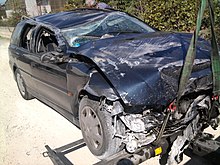 Some crash types tend to have more serious consequences. Rollovers have become more common in recent years, perhaps due to increased popularity of taller SUVs, people carriers, and minivans, which have a higher center of gravity than standard passenger cars. Rollovers can be fatal, especially if the occupants are ejected because they were not wearing seat belts (83% of ejections during rollovers were fatal when the driver did not wear a seat belt, compared to 25% when they did). After a new design of Mercedes Benz notoriously failed a moose test (sudden swerving to avoid an obstacle), some manufacturers enhanced suspension using stability control linked to an anti-lock braking system to reduce the likelihood of rollover. After retrofitting these systems to its models in 1999–2000, Mercedes saw its models involved in fewer crashes.
Now, about 40% of new US vehicles, mainly the SUVs, vans and pickup trucks that are more susceptible to rollover, are being produced with a lower center of gravity and enhanced suspension with stability control linked to its anti-lock braking system to reduce the risk of rollover and meet US federal requirements that mandate anti-rollover technology by September 2011.
Some crash types tend to have more serious consequences. Rollovers have become more common in recent years, perhaps due to increased popularity of taller SUVs, people carriers, and minivans, which have a higher center of gravity than standard passenger cars. Rollovers can be fatal, especially if the occupants are ejected because they were not wearing seat belts (83% of ejections during rollovers were fatal when the driver did not wear a seat belt, compared to 25% when they did). After a new design of Mercedes Benz notoriously failed a moose test (sudden swerving to avoid an obstacle), some manufacturers enhanced suspension using stability control linked to an anti-lock braking system to reduce the likelihood of rollover. After retrofitting these systems to its models in 1999–2000, Mercedes saw its models involved in fewer crashes.
Now, about 40% of new US vehicles, mainly the SUVs, vans and pickup trucks that are more susceptible to rollover, are being produced with a lower center of gravity and enhanced suspension with stability control linked to its anti-lock braking system to reduce the risk of rollover and meet US federal requirements that mandate anti-rollover technology by September 2011.
Human factors
Man with visible facial scars resulting from a car accident
- controlling a car including a good awareness of the cars size and capabilities
- reading and reacting to road conditions, weather, road signs and the environment
- alertness, reading and anticipating the behavior of other drivers.
...the feeling of being confident in more and more challenging situations is experienced as evidence of driving ability, and that proven ability reinforces the feelings of confidence. Confidence feeds itself and grows unchecked until something happens – a near-miss or an accident.An AXA survey concluded Irish drivers are very safety-conscious relative to other European drivers. However, this does not translate to significantly lower crash rates in Ireland. Accompanying changes to road designs have been wide-scale adoptions of rules of the road alongside law enforcement policies that included drink-driving laws, setting of speed limits, and speed enforcement systems such as speed cameras. Some countries driving tests have been expanded to test a new drivers behavior during emergencies, and their hazard perception. There are demographic differences in crash rates. For example, although young people tend to have good reaction times, disproportionately more young male drivers feature in collisions,with researchers observing that many exhibit behaviors and attitudes to risk that can place them in more hazardous situations than other road users. This is reflected by actuaries when they set insurance rates for different age groups, partly based on their age, sex, and choice of vehicle. Older drivers with slower reactions might be expected to be involved in more collisions, but this has not been the case as they tend to drive less and, apparently, more cautiously. Attempts to impose traffic policies can be complicated by local circumstances and driver behavior. In 1969 Leeming warned that there is a balance to be struck when improving the safety of a road: Conversely, a location that does not look dangerous may have a high crash frequency. This is, in part, because if drivers perceive a location as hazardous, they take more care. Collisions may be more likely to happen when hazardous road or traffic conditions are not obvious at a glance, or where the conditions are too complicated for the limited human machine to perceive and react in the time and distance available. High incidence of crashes is not indicative of high injury risk. Crashes are common in areas of high vehicle congestion but fatal crashes occur disproportionately on rural roads at night when traffic is relatively light. This phenomenon has been observed in risk compensation research, where the predicted reductions in collision rates have not occurred after legislative or technical changes. One study observed that the introduction of improved brakes resulted in more aggressive driving and another argued that compulsory seat belt laws have not been accompanied by a clearly attributed fall in overall fatalities. Most claims of risk compensation offsetting the effects of vehicle regulation and belt use laws has been discredited by research using more refined data. In the 1990s, Hans Mondermans studies of driver behavior led him to the realization that signs and regulations had an adverse effect on a drivers ability to interact safely with other road users. Monderman developed shared space principles, rooted in the principles of the woonerven of the 1970s. He concluded that the removal of highway clutter, while allowing drivers and other road users to mingle with equal priority, could help drivers recognize environmental clues. They relied on their cognitive skills alone, reducing traffic speeds radically and resulting in lower levels of road casualties and lower levels of congestion. Some crashes are intended; staged crashes, for example, involve at least one party who hopes to crash a vehicle in order to submit lucrative claims to an insurance company.In the USA in the 1990s, criminals recruited Latin immigrants to deliberately crash cars, usually by cutting in front of another car and slamming on the brakes. It was an illegal and risky job, and they were typically paid only $100. Jose Luis Lopez Perez, a staged crash driver, died after one such maneuver, leading to an investigation that uncovered the increasing frequency of this type of crash.
Motor vehicle speed
Police car accident
- The evidence shows the risk of having a crash is increased both for vehicles traveling slower than the average speed, and for those traveling above the average speed.
- The risk of being injured increases exponentially with speeds much faster than the median speed.
- The severity/lethality of a crash depends on the vehicle speed change at impact.
- There is limited evidence suggesting lower speed limits result in lower speeds on a system-wide basis.
- Most crashes related to speed involve speed too fast for the conditions.
- More research is needed to determine the effectiveness of traffic calming.
Driver impairment
Driver impairment describes factors that prevent the driver from driving at their normal level of skill. Common impairments include:- Alcohol
Main article: Driving under the influence
Relative risk of collisions based on blood alcohol levels
- Physical impairment
- Youth
- Old age
- Sleep deprivation
- Drug use
- Distraction
- Combinations of factors
- Combining low doses of alcohol and cannabis has a more severe effect on driving performance than either cannabis or alcohol in isolation, or
- Taking recommended doses of several drugs together, which individually do not cause impairment, may combine to bring on drowsiness or other impairment. This could be more pronounced in an elderly person whose renal function is less efficient than a younger persons.
Road design
A potential long fall stopped by an early guardrail, ca. 1920. Guardrails, median barriers, or other physical objects can help reduce the consequences of a collision or minimize damage.
Vehicle design and maintenance
Seatbelts
- Maintenance
- Center of gravity
An Opel Vectra involved in a rollovercrash
- Motorcycles
Other
Other possibly hazardous factors that may alter a drivers soundness on the road includes:- Irritability,
- Following specifically distinct rules too bureaucratically, inflexibly or rigidly when unique circumstances might suggest otherwise
- Sudden swerving into somebodys blind spot without first clearly making oneself visible through the wing mirror
- Unfamiliarity with ones dashboard features, center console or other interior handling devices after a recent car purchase
- Lack of visibility due to windshield design or sun glare
- Distraction by scenery, a sexually attractive person or sexually suggestive advertising
Loading ad...
A 1985 study by R. Kumar, using British and American crash reports as data, suggested 57% of crashes were due solely to driver factors, 27% to combined roadway and driver factors, 6% to combined vehicle and driver factors, 3% solely to roadway factors, 3% to combined roadway, driver, and vehicle factors, 2% solely to vehicle factors, and 1% to combined roadway and vehicle factors. Reducing the severity of injury in crashes is more important than reducing incidence and ranking incidence by broad categories of causes is misleading regarding severe injury reduction. Vehicle and road modifications are generally more effective than behavioral change efforts with the exception of certain laws such as required use of seat belts, motorcycle helmets and graduated licensing of teenagers.
Human factors in vehicle collisions include all factors related to drivers and other road users that may contribute to a collision. Examples include driver behavior, visual and auditory acuity, decision-making ability, and reaction speed.
Intent is also a factor, a vehicle-ramming attack for a example happens largely due to a driver choosing to cause a traffic collision.
A 1985 report based on British and American crash data found driver error, intoxication and other human factors contribute wholly or partly to about 93% of crashes.
Drivers distracted by mobile devices had nearly four times greater risk of crashing their cars than those who were not. Dialing a phone is the most dangerous distraction, increasing a drivers’ chance of crashing by 12 times, followed by reading or writing, which increased the risk by 10 times.
An RAC survey of British drivers found that most[quantify] thought they were better than average drivers; a contradictory result showing overconfidence in their abilities.[citation needed] Nearly all drivers who had been in a crash did not believe themselves to be at fault.One survey of drivers reported that they thought the key elements of good driving were:
The U.S. Department of Transportations Federal Highway Administration review research on traffic speed in 1998. The summary says:
According to the Government of Canada, coroner reports from 2008 suggested almost 40% of fatally injured drivers consumed some quantity of alcohol before the collision.[32]
A 1985 US study showed that about 34% of serious crashes had contributing factors related to the roadway or its environment. Most of these crashes also involved a human factor. The road or environmental factor was either noted as making a significant contribution to the circumstances of the crash, or did not allow room to recover. In these circumstances it is frequently the driver who is blamed rather than the road; those reporting the collisions have a tendency to overlook the human factors involved, such as the subtleties of design and maintenance that a driver could fail to observe or inadequately compensate for.
Research has shown that careful design and maintenance, with well-designed intersections, road surfaces, visibility and traffic control devices, can result in significant improvements in collision rates.
Individual roads also have widely differing performance in the event of an impact. In Europe there are now EuroRAP tests that indicate how self-explaining and forgiving a particular road and its roadside would be in the event of a major incident.
In the UK, research has shown that investment in a safe road infrastructure program could yield a ⅓ reduction in road deaths, saving as much as £6 billion per year. A consortium of 13 major road safety stakeholders have formed the Campaign for Safe Road Design, which is calling on the UK Government to make safe road design a national transport priority.
Research has shown that, across all collision types, it is less likely that seat belts were worn in collisions involving death or serious injury, rather than light injury; wearing a seat belt reduces the risk of death by about 45 percent. Seat belt use is controversial, with notable critics such as Professor John Adams suggesting that their use may lead to a net increase in road casualties due to a phenomenon known as risk compensation.However, actual observation of driver behaviors before and after seat belt laws does not support the risk compensation hypothesis. Several important driving behaviors were observed on the road before and after the belt use law was enforced in Newfoundland, and in Nova Scotia during the same period without a law. Belt use increased from 16 percent to 77 percent in Newfoundland and remained virtually unchanged in Nova Scotia. Four driver behaviors (speed, stopping at intersections when the control light was amber, turning left in front of oncoming traffic, and gaps in following distance) were measured at various sites before and after the law. Changes in these behaviors in Newfoundland were similar to those in Nova Scotia, except that drivers in Newfoundland drove slower on expressways after the law, contrary to the risk compensation theory.
Some crash types tend to have more serious consequences. Rollovers have become more common in recent years, perhaps due to increased popularity of taller SUVs, people carriers, and minivans, which have a higher center of gravity than standard passenger cars. Rollovers can be fatal, especially if the occupants are ejected because they were not wearing seat belts (83% of ejections during rollovers were fatal when the driver did not wear a seat belt, compared to 25% when they did). After a new design of Mercedes Benz notoriously failed a moose test (sudden swerving to avoid an obstacle), some manufacturers enhanced suspension using stability control linked to an anti-lock braking system to reduce the likelihood of rollover. After retrofitting these systems to its models in 1999–2000, Mercedes saw its models involved in fewer crashes.
Now, about 40% of new US vehicles, mainly the SUVs, vans and pickup trucks that are more susceptible to rollover, are being produced with a lower center of gravity and enhanced suspension with stability control linked to its anti-lock braking system to reduce the risk of rollover and meet US federal requirements that mandate anti-rollover technology by September 2011.
Human factors
Man with visible facial scars resulting from a car accident
- controlling a car including a good awareness of the cars size and capabilities
- reading and reacting to road conditions, weather, road signs and the environment
- alertness, reading and anticipating the behavior of other drivers.
...the feeling of being confident in more and more challenging situations is experienced as evidence of driving ability, and that proven ability reinforces the feelings of confidence. Confidence feeds itself and grows unchecked until something happens – a near-miss or an accident.An AXA survey concluded Irish drivers are very safety-conscious relative to other European drivers. However, this does not translate to significantly lower crash rates in Ireland. Accompanying changes to road designs have been wide-scale adoptions of rules of the road alongside law enforcement policies that included drink-driving laws, setting of speed limits, and speed enforcement systems such as speed cameras. Some countries driving tests have been expanded to test a new drivers behavior during emergencies, and their hazard perception. There are demographic differences in crash rates. For example, although young people tend to have good reaction times, disproportionately more young male drivers feature in collisions,with researchers observing that many exhibit behaviors and attitudes to risk that can place them in more hazardous situations than other road users. This is reflected by actuaries when they set insurance rates for different age groups, partly based on their age, sex, and choice of vehicle. Older drivers with slower reactions might be expected to be involved in more collisions, but this has not been the case as they tend to drive less and, apparently, more cautiously. Attempts to impose traffic policies can be complicated by local circumstances and driver behavior. In 1969 Leeming warned that there is a balance to be struck when improving the safety of a road: Conversely, a location that does not look dangerous may have a high crash frequency. This is, in part, because if drivers perceive a location as hazardous, they take more care. Collisions may be more likely to happen when hazardous road or traffic conditions are not obvious at a glance, or where the conditions are too complicated for the limited human machine to perceive and react in the time and distance available. High incidence of crashes is not indicative of high injury risk. Crashes are common in areas of high vehicle congestion but fatal crashes occur disproportionately on rural roads at night when traffic is relatively light. This phenomenon has been observed in risk compensation research, where the predicted reductions in collision rates have not occurred after legislative or technical changes. One study observed that the introduction of improved brakes resulted in more aggressive driving and another argued that compulsory seat belt laws have not been accompanied by a clearly attributed fall in overall fatalities. Most claims of risk compensation offsetting the effects of vehicle regulation and belt use laws has been discredited by research using more refined data. In the 1990s, Hans Mondermans studies of driver behavior led him to the realization that signs and regulations had an adverse effect on a drivers ability to interact safely with other road users. Monderman developed shared space principles, rooted in the principles of the woonerven of the 1970s. He concluded that the removal of highway clutter, while allowing drivers and other road users to mingle with equal priority, could help drivers recognize environmental clues. They relied on their cognitive skills alone, reducing traffic speeds radically and resulting in lower levels of road casualties and lower levels of congestion. Some crashes are intended; staged crashes, for example, involve at least one party who hopes to crash a vehicle in order to submit lucrative claims to an insurance company.In the USA in the 1990s, criminals recruited Latin immigrants to deliberately crash cars, usually by cutting in front of another car and slamming on the brakes. It was an illegal and risky job, and they were typically paid only $100. Jose Luis Lopez Perez, a staged crash driver, died after one such maneuver, leading to an investigation that uncovered the increasing frequency of this type of crash.
Motor vehicle speed
Police car accident
- The evidence shows the risk of having a crash is increased both for vehicles traveling slower than the average speed, and for those traveling above the average speed.
- The risk of being injured increases exponentially with speeds much faster than the median speed.
- The severity/lethality of a crash depends on the vehicle speed change at impact.
- There is limited evidence suggesting lower speed limits result in lower speeds on a system-wide basis.
- Most crashes related to speed involve speed too fast for the conditions.
- More research is needed to determine the effectiveness of traffic calming.
Driver impairment
Driver impairment describes factors that prevent the driver from driving at their normal level of skill. Common impairments include:- Alcohol
Main article: Driving under the influence
Relative risk of collisions based on blood alcohol levels
- Physical impairment
- Youth
- Old age
- Sleep deprivation
- Drug use
- Distraction
- Combinations of factors
- Combining low doses of alcohol and cannabis has a more severe effect on driving performance than either cannabis or alcohol in isolation, or
- Taking recommended doses of several drugs together, which individually do not cause impairment, may combine to bring on drowsiness or other impairment. This could be more pronounced in an elderly person whose renal function is less efficient than a younger persons.
Road design
A potential long fall stopped by an early guardrail, ca. 1920. Guardrails, median barriers, or other physical objects can help reduce the consequences of a collision or minimize damage.
Vehicle design and maintenance
Seatbelts
- Maintenance
- Center of gravity
An Opel Vectra involved in a rollovercrash
- Motorcycles
Other
Other possibly hazardous factors that may alter a drivers soundness on the road includes:- Irritability,
- Following specifically distinct rules too bureaucratically, inflexibly or rigidly when unique circumstances might suggest otherwise
- Sudden swerving into somebodys blind spot without first clearly making oneself visible through the wing mirror
- Unfamiliarity with ones dashboard features, center console or other interior handling devices after a recent car purchase
- Lack of visibility due to windshield design or sun glare
- Distraction by scenery, a sexually attractive person or sexually suggestive advertising
