The pledge made by world leaders in the Paris Agreement three years ago to stop temperature rising by less than 2-degree-Celsius and working to keep the increase as close as possible to 1.5-degree-Celsius, “were really the bare minimum to avoid the worst impacts of climate change,” said Secretary-General Guterres, in a landmark speech on climate action, at UN Headquarters in New York.
“The mountain in front of us is very high but it is not insurmountable. We know how to scale it,” he continued.
“Put simply, we need to put the brake on deadly greenhouse gas emissions and drive climate action,” he added, calling for a shift away from the dependency on fossil fuels towards cleaner energy and away from deforestation to more efficient use of resources.
The future Put simply, we need to put the brake on deadly greenhouse gas emissions and drive climate actionThe UN chief went on to say that such a shift in thinking is where “enormous benefits await humankind.” “I have heard the argument – usually from vested interests – that tackling climate change is expensive and could harm economic growth. This is hogwash. In fact, the opposite is true,” he stressed. In his message, Mr. Guterres highlighted the huge economic costs of climate change and the opportunities presented by climate action.
UN Photo/Eskinder Debebe
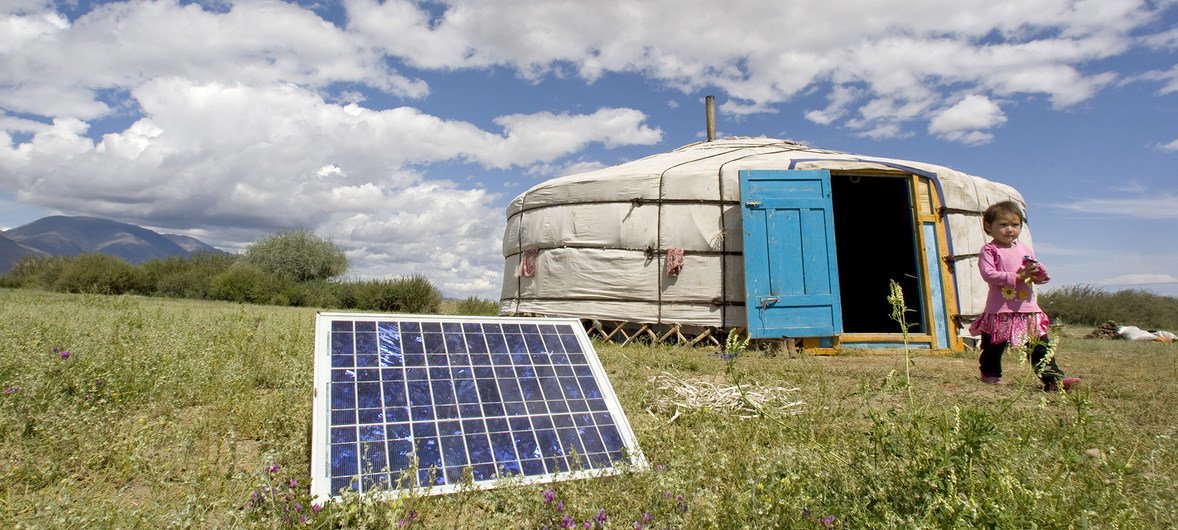
A family in Uvs Province, Mongolia, using a solar panel to generate power for their ger, a traditional Mongolian tent
Climate action, socio-economic progress mutually supportive
“Climate action and socio-economic progress are mutually supportive, with gains of 26 trillion dollars predicted by 2030 compared with business as usual, if we pursue the right path,” he said, citing the findings of the recent Climate Economy report from the Global Commission on the Economy and Climate Change. Benefits The benefits transcend monetary figures. “Climate-resilient water supply and sanitation could save the lives of more than 360,000 infants every year, clean air has vast benefits for public health [and] in China and the United States, new renewable energy jobs now outstrip those created in the oil and gas industries,” explained Mr. Guterres, noting several examples from across the world of climate action resulting in enormous benefits for countries and communities. Underscoring that important strides are being made, the UN chief highlighted the imperative to speed up these transitions.There is another reason to act – moral duty … the world’s richest nations are the most responsible for the climate crisis, yet the effects are being felt first and worst by the poorest nations and the most vulnerable peoples and communities“And for that to happen, the leaders of the world need to step up. The private sector, of course, is poised to move, and many are doing so. Impact In his remarks, Secretary-General Guterres highlighted the skewed impact of the climate crisis on vulnerable nations and urged richer countries to do more to assist them. Looking ahead, the UN chief emphasized that he would be reiterating this message at the General Assembly’s high level segment later in the month as well as at other key events, including the G7 and G20 meetings of world leaders; and the World Bank and International Monetary Fund (IMF) meetings. “The time has come for our leaders to show they care about the people whose fate they hold in their hands. We need them to show they care about the future,” he stressed.
