Experiments on Formation of the Early Solar System and Understanding Parkinsons Disease.It is carrying the Refabricator ,the first-ever 3D printer and recycler integrated into one user-friendly machine, to start recycling in space.The new experiments include a demonstration of 3D printing and recycling technology and simulating the creation of celestial bodies from stardust.
Northrop Grummans Cygnus spacecraft is on its way to the International Space Station with about 7,400 pounds of cargo after launching at 4:01 a.m. EST Saturday from NASAs Wallops Flight Facility on Virginias Eastern Shore.
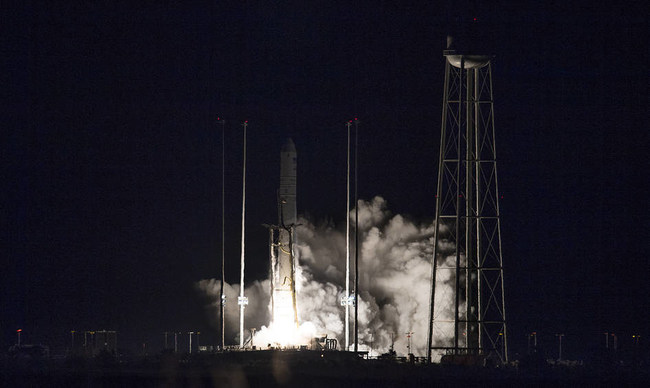
The Northrop Grumman Antares rocket, with Cygnus resupply spacecraft onboard, launches from Pad-0A, Saturday, Nov. 17, 2018, at NASAs Wallops Flight Facility in Virginia. Northrop Grummans 10th contracted cargo resupply mission for NASA to the International Space Station will deliver about 7,400 pounds of science and research, crew supplies and vehicle hardware to the orbital laboratory and its crew. Credit: NASA/Joel Kowsky
The spacecraft launched on an Antares 230 Rocket from the Virginia Mid-Atlantic Regional Spaceports Pad 0A at Wallops on the companys 10th cargo delivery flight, and is scheduled to arrive at the orbital laboratory Monday, Nov. 19. Expedition 57 astronauts Serena Auñón-Chancellor of NASA and Alexander Gerst of ESA (European Space Agency) will use the space stations robotic arm to grapple Cygnus about 5:20 a.m. Installation coverage will begin at 4 a.m. on NASA Television and the agencys website.
This Commercial Resupply Services contract mission will support dozens of new and existing investigations as Expeditions 57 and 58 contribute to some 250 science and research studies. Highlights from the new experiments include a demonstration of 3D printing and recycling technology and simulating the creation of celestial bodies from stardust.
Cygnus spacecraft will remain at the space station until February
The Cygnus spacecraft will remain at the space station until February before its destructive reentry into Earths atmosphere, disposing of several thousand pounds of trash. This is the seventh flight of an enhanced Cygnus spacecraft, and the fourth using Northrop Grummans upgraded Antares 230 launch vehicle featuring new RD-181 engines that provide increased performance and flexibility.
The mission is named in honor of astronaut John Young
The spacecraft for this mission is named in honor of astronaut John Young. Young was selected for NASAs second astronaut class and flew during the Gemini, Apollo and Space Shuttle programs. He walked on the Moon during Apollo 16 in 1972 and commanded the first space shuttle mission in 1981. Young passed away in January.
International Space Station
For more than 18 years, humans have lived and worked continuously aboard the International Space Station, advancing scientific knowledge and demonstrating new technologies, making research breakthroughs not possible on Earth that will enable long-duration human and robotic exploration into deep space. A global endeavor, 230 people from 18 countries have visited the unique microgravity laboratory that has hosted more than 2,500 research investigations from researchers in 106 countries.
emergency manager17 November 2018
NASA Launch Space Station, National Lab Cargo
1289
Share it on:
Loading ad...
Experiments on Formation of the Early Solar System and Understanding Parkinsons Disease.It is carrying the Refabricator ,the first-ever 3D printer and recycler integrated into one user-friendly machine, to start recycling in space.The new experiments include a demonstration of 3D printing and recycling technology and simulating the creation of celestial bodies from stardust.
Northrop Grummans Cygnus spacecraft is on its way to the International Space Station with about 7,400 pounds of cargo after launching at 4:01 a.m. EST Saturday from NASAs Wallops Flight Facility on Virginias Eastern Shore.
The Northrop Grumman Antares rocket, with Cygnus resupply spacecraft onboard, launches from Pad-0A, Saturday, Nov. 17, 2018, at NASAs Wallops Flight Facility in Virginia. Northrop Grummans 10th contracted cargo resupply mission for NASA to the International Space Station will deliver about 7,400 pounds of science and research, crew supplies and vehicle hardware to the orbital laboratory and its crew. Credit: NASA/Joel Kowsky
The spacecraft launched on an Antares 230 Rocket from the Virginia Mid-Atlantic Regional Spaceports Pad 0A at Wallops on the companys 10th cargo delivery flight, and is scheduled to arrive at the orbital laboratory Monday, Nov. 19. Expedition 57 astronauts Serena Auñón-Chancellor of NASA and Alexander Gerst of ESA (European Space Agency) will use the space stations robotic arm to grapple Cygnus about 5:20 a.m. Installation coverage will begin at 4 a.m. on NASA Television and the agencys website.
This Commercial Resupply Services contract mission will support dozens of new and existing investigations as Expeditions 57 and 58 contribute to some 250 science and research studies. Highlights from the new experiments include a demonstration of 3D printing and recycling technology and simulating the creation of celestial bodies from stardust.
Cygnus spacecraft will remain at the space station until February
The Cygnus spacecraft will remain at the space station until February before its destructive reentry into Earths atmosphere, disposing of several thousand pounds of trash. This is the seventh flight of an enhanced Cygnus spacecraft, and the fourth using Northrop Grummans upgraded Antares 230 launch vehicle featuring new RD-181 engines that provide increased performance and flexibility.
The mission is named in honor of astronaut John Young
The spacecraft for this mission is named in honor of astronaut John Young. Young was selected for NASAs second astronaut class and flew during the Gemini, Apollo and Space Shuttle programs. He walked on the Moon during Apollo 16 in 1972 and commanded the first space shuttle mission in 1981. Young passed away in January.
International Space Station
For more than 18 years, humans have lived and worked continuously aboard the International Space Station, advancing scientific knowledge and demonstrating new technologies, making research breakthroughs not possible on Earth that will enable long-duration human and robotic exploration into deep space. A global endeavor, 230 people from 18 countries have visited the unique microgravity laboratory that has hosted more than 2,500 research investigations from researchers in 106 countries.